
 Call Us
  Menu
Menu
Why the Orangery Is Becoming the Smartest Extension in Commercial Design
22nd January, 2026For years, the orangery has been viewed as a symbol of domestic aspiration: a light-filled retreat at the back of a handsome home, somewhere between garden and living room. Yet a quiet shift is underway. Increasingly, the orangery is stepping beyond just the private sphere and into the commercial world, where wedding venues, restaurants and hospitality businesses are discovering its unique ability to combine elegance, practicality and commercial return.
In an era when experience matters as much as product, space has become a powerful differentiator. For wedding venues in particular, the demand is clear. Couples are no longer satisfied with a single-purpose hall; they want flexibility, light, and a sense of occasion. A wedding venue orangery answers all three, offering a refined architectural setting that feels celebratory without being overbearing.
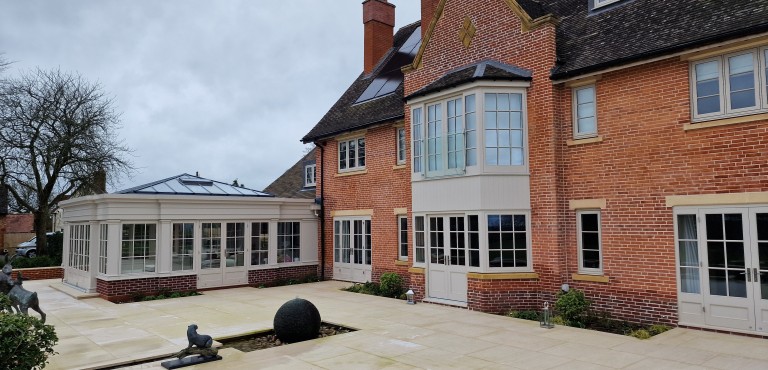
Unlike marquees which are temporary, weather-dependent and increasingly expensive, an orangery is permanent, insulated and usable year-round. For venues, this means certainty: bookings are not lost to rain or cold snaps, and the space can be marketed confidently in every season. For guests, it delivers atmosphere: tall glazing, lantern roofs and solid perimeter detailing create a room that feels both grand and grounded.
The same logic applies across the hospitality sector. A restaurant orangery allows operators to expand covers without compromising identity. Where traditional extensions can feel bolted on, an orangery offers architectural continuity, particularly for period buildings, country estates and heritage sites. The result is a dining space that feels intentional rather than opportunistic, an important distinction for discerning customers.
Crucially, these structures are not simply aesthetic statements. From a commercial perspective, an orangery is a highly efficient use of capital. Well-designed commercial orangeries provide excellent thermal performance, helping businesses avoid the soaring heating costs associated with older glazed extensions. Modern construction methods mean large spans can be achieved without excessive steelwork, keeping sightlines clean and interiors adaptable.
Flexibility is perhaps the orangery’s greatest strength. For wedding venues, it can function as a ceremony room, reception space, dining area or evening bar—all within the same footprint. For restaurants, it can transition seamlessly from breakfast to evening service, or be hired privately for events without closing the main dining room. These multi-use capabilities make orangeries particularly attractive as wedding venue extensions, where return on investment is driven by versatility as much as capacity.
There is also a branding advantage. In an age dominated by social media, light-filled spaces photograph exceptionally well. A well-proportioned orangery becomes part of a venue’s visual identity, appearing in brochures, Instagram feeds and wedding albums alike. The architectural language - symmetry, proportion, craftsmanship - signals quality before a single word is spoken.
Importantly, the orangery challenges the assumption that such spaces are reserved for homeowners with generous gardens. In reality, commercial sites often stand to gain more. Planning authorities are frequently receptive to orangeries because they sit comfortably between traditional architecture and modern use. Their solid roof sections and classical proportions are often viewed more favourably than fully glazed alternatives, particularly in conservation areas or sensitive settings.
From boutique hotels to countryside inns, the orangery is increasingly seen as a way to future-proof a business. As customer expectations rise, venues must offer more than utility. They must offer atmosphere, adaptability and a sense of permanence. An orangery provides all three, while remaining remarkably understated.
This is perhaps why the trend feels less like a fashion and more like a correction. For too long, commercial extensions have prioritised speed over substance. The orangery reverses that logic, proving that commercial spaces can be both profitable and beautiful.
As wedding venues compete for bookings and restaurants seek to stand out in a crowded market, the orangery offers a compelling proposition: a space that works hard financially while elevating the experience for everyone who steps inside. Not merely an addition, but an investment in longevity.
In short, the orangery has grown up. No longer just confined to private homes, it is fast becoming one of the most intelligent architectural moves a commercial venue can make - quietly elegant, commercially astute, and built to last.

We explore why orangeries are not just for private homes, but are becoming one of the most valuable and versatile extensions for commercial spaces such as wedding venues and restaurants. A well-designed orangery can enhance guest experience, increase year-round usability, and deliver strong commercial returns while elevating the character of a venue.
Read Article
When it comes to choosing windows for your home, the debate between real timber windows and uPVC timber-look alternatives is a common one. We look at the reasons that a real timber window is the superior choice.
Read Article
We take a look at what the planning requirements are for a Conservatory or Orangery in the UK
Read Article Prev Article